HOLD TO THIS EARTH: INDIGENOUS NORTH AMERICAN ART AT YORKSHIRE SCULPTURE PARK
The drive into Yorkshire Sculpture Park takes you past three bronzes on a far hill, presently on loan to the nearby Henry Moore Foundation. Five hundred acres of eighteenth-century parkland, the former Bretton Hall estate, make this the largest sculpture park in Europe. It is also, this year, an institution under new leadership: Joe Hill, who grew up in the area and watched the park develop from its modest beginnings into an internationally recognised museum, has taken over as Director in time to launch one of the most ambitious shows YSP has mounted.
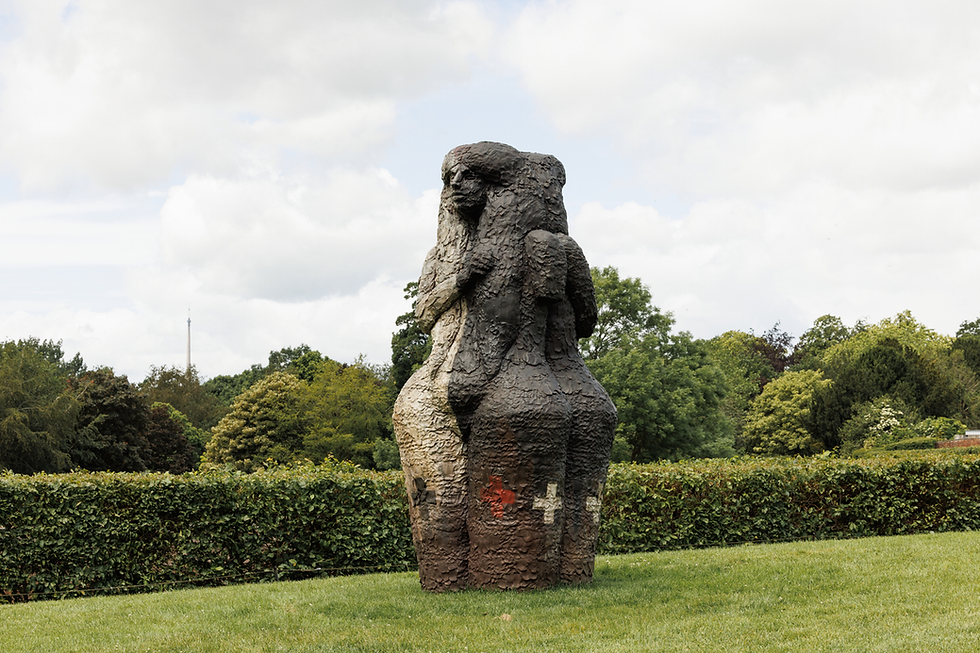
Raven Halfmoon, The Guardians, 2026. Courtesy of Tia Collection. Photo © India Hobson, courtesy YSP.
That show is Hold to This Earth: Works by Contemporary Indigenous North American Artists from Tia Collection: sixty-seven works by thirty-eight artists representing more than thirty-five Tribal Nations, with three new commissions, and the first group exhibition staged in YSP's Underground Gallery in the building's twenty-year history. By the park's own reckoning it is the largest exhibition of contemporary Indigenous North American art ever brought to the UK.
The works are drawn from Tia Collection, the Santa Fe collection founded in 2007 that has held Indigenous North American art at its centre from the start. Sarah Coulson, who curated the show, describes a single thread running through every room: the connection between people and land, approached through memory, material, sovereignty and inheritance.

Dakota Mace, Kéyah Yinílniih (The Land Remembers), 2026. Courtesy of Tia Collection. Photo © India Hobson, courtesy YSP.
At the entrance is a new commission from Dakota Mace, Kéyah Yinílniih (The Land Remembers), an earthen abstract painting that fills an entire wall. Mace developed it from a cyanotype she made on site at YSP, laying the photographic process directly onto Yorkshire soil, then worked into it with natural dyes traditional to the region (woad, weld, madder) alongside clay and wool gathered locally and earth carried from her home of Teejop, bringing two places into one surface. She has described the piece as a love-letter to Yorkshire, and a way of thinking about the memories held within land.
The three galleries move through distinct registers. The first is grounded in touch and in materials worked by hand across generations, with matrilineal lines running through the Pueblo ceramics of Rose B. Simpson, whose Tonantzin shares a space with work by her mother Roxanne Swentzell, and through Tyrrell Tapaha, a sixth-generation Diné weaver and shepherd who makes textiles from his own flock. The central gallery is openly political, given over to protest and sovereignty: Yatika Starr Fields builds with tents recovered from Standing Rock, and Zoë Urness's photograph confronts the crisis of Missing and Murdered Indigenous Women and Girls, an emergency whose scale Coulson admits she had not grasped. The last gallery turns to abstraction and to the natural set against the synthetic, with Teresa Baker's landscapes built on artificial turf and Jeffrey Gibson's TO MY NATION setting beadwork beside a line from Gladys Knight.
Hold to This Earth, 2026. Courtesy of Tia Collection. Photo © India Hobson, courtesy YSP.
Two of the artists working in beadwork gave Fetch some time at the opening, and their conversations sit at the centre of what the show is doing. Sayo':kla Kindness-Williams is Oneida, based now in Wisconsin, and has been beading since she was eight. Her work is, she says, "the first beaded protest sign ever," made in solidarity with the occupation at 1492 Landback Lane on the Six Nations reserve in Ontario, where she was living during the pandemic when a parcel of land was illegally sold and the community moved to reoccupy it. The image at its centre comes from a press photograph taken during the protest, when demonstrators put a broken-down school bus across a major road and threw a car on top of it.
Sayo':kla Kindness-Williams, Land Back: Thanksgiving Haudenosaunee Land Back Protestors/Defenders, 2021-22. Sayo':kla Kindness-Williams portrait. Photo © Paolina Hurry, courtesy YSP.
She reads the imagery for me as we stood in front of it: the Two Row Wampum, Turtle Island, the Great Lakes, the Tree of Peace, an eagle watching over the Haudenosaunee Confederacy. The shawl fringe is built to make noise when carried, and she wants it used. "I really want it in a protest someday," she tells me, explaining that she chose a hollow metal pole over wood because wooden sticks read as weapons and are increasingly barred from demonstrations. "Anything could be used as a weapon."
"It's not just land back. It's culture back. It's language back."
What she keeps returning to is that the demand has never been only about territory.. "We want our own identity back, our ways of culture. So it's more than just land. Everything is connected to our homelands." She talks about her community's removal from six million acres in New York two centuries ago, women crying on arrival in Wisconsin with nothing built to receive them, as well as the single remaining fluent speaker of her language at home, which is why she moved her son to Ontario for Mohawk immersion before the pandemic closed the school. "When we defend our territories, we're serious about it."

Hold to This Earth, 2026. Courtesy of Tia Collection. Photo © India Hobson, courtesy YSP.
Similarly, Dyani White Hawk, Lakota and based in Minnesota, makes large-scale collaborative beadwork. The piece in the show, Visiting II (2024-25) is the second in a series, with a third under way, and it is made by an eleven-person studio crew, nine of them Indigenous North American and most of them her family: her daughter, her sister-in-law, her Navajo mother-in-law, her brother-in-law, nieces, cousins, a best friend's aunt. The decision to work only with Native makers is part of the work for her. "I want to make sure that those are all other native artists as well, and native creators that come from that lineage, as opposed to asking non-native people to mimic our work," she said. "It means something different."
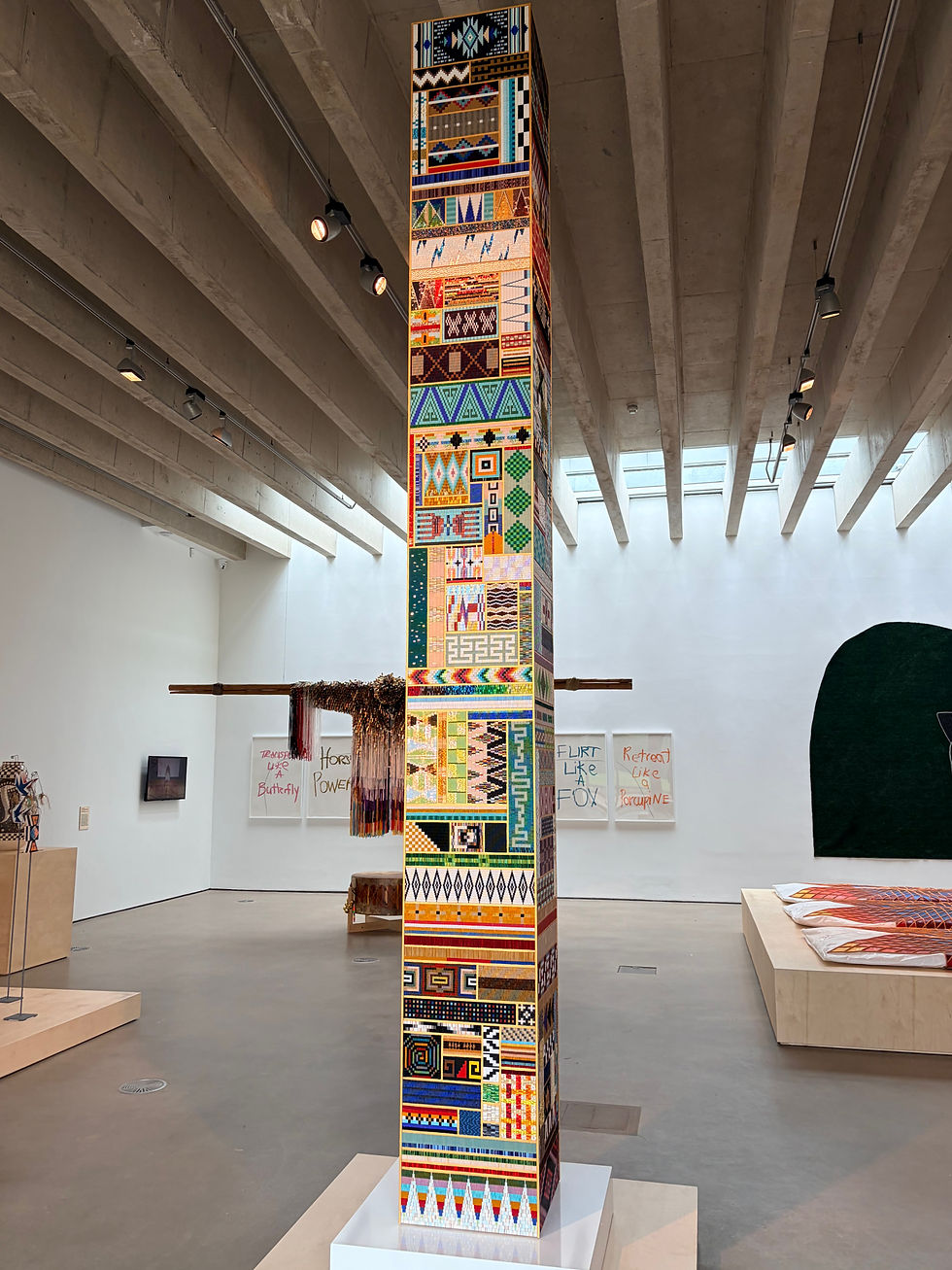
Dyani White Hawk, Visiting II 2024-2025. Courtesy of Tia Collection. Photo © Fetch London
This was the first piece in which she gave the crew creative freedom rather than templates to follow, borrowing the logic of a crazy quilt assembled from whatever beadwork was to hand. "This was the first time that they have had any creative freedom in the studio," she said. "A lot of them were really resistant. They were like, 'I don't have ideas, I'm not an artist.' I'm like, 'I believe in you.'" Over the three works their styles have become distinct enough to recognise on sight. "They went from 'I don't have ideas' to wildly complex compositions." The result, she said, brought intuition back into a practice she otherwise describes as highly controlled.
"All we need to do is move towards more honest storytelling."
She is clear about why this matters in Europe. Securing recognition for the work of Indigenous artists has been a long struggle even at home, she explained, which raises the stakes of showing it abroad. "This is American history," she said. "American art history starts with Indigenous artistry. To leave that out of America cheats everyone, and it diminishes the richness of that history."

Allan Houser, Watercarrier, 1986. Courtesy of Tia Collection. Photo © India Hobson, courtesy YSP.
Outdoors, six Indigenous works are placed in conversation with the landscape, as well as three further exhibitions rewarding the walk into the park. In the eighteenth-century Chapel, Nicola Turner's Time's Scythe begins on the building's exterior, spilling from the belfry and threading in through an upper window before falling over the balcony into the nave. Made from wool and horsehair encased in mesh, its bulbous, sinuous masses invite visitors to walk among them, the earthy smell of the wool sharpening the effect. This is Turner's first large-scale work in pale wool, a shift from the darker, heavier sculptures that made her name, including the installation that wound around the statue of Joshua Reynolds at the Royal Academy in 2024. Traditional sheep shears reach pincer-like from the tips of the tendrils towards the altar, linking the work both to the flock grazing outside and to Sheffield's toolmaking history. The title comes from Shakespeare's twelfth sonnet, and references the Chapel's dedication to St Bartholomew, the flayed martyr and patron saint of skin and cutting.
Nicola Turner, Time's Scythe. Presented in collaboration with Annely Juda Fine Art. Photo © Mark Reeves, courtesy YSP.
In the Weston Gallery, LR Vandy's Rise, her first solo museum exhibition, centres on a monumental rope maypole, A Call to Dance, made on site. Vandy works from a studio at Chatham Historic Dockyard, the last Royal Navy ropeyard still in operation. Outdoors, the five-metre Dancing in Time: The Ties That Bind Us, first commissioned by Liverpool's International Slavery Museum, now overlooks the Yorkshire hills.
LR Vandy, Rise, installation view at Yorkshire Sculpture Park, 2026. In collaboration with October Gallery. Photo © India Hobson, courtesy YSP.

The strangest encounter is kept for last. Roger Hiorns's Seizure, reopened for the summer, sits in a purpose-built structure at the far end of the park. In the mid-2000s, Hiorns took an abandoned bedsit in a London tower block due for demolition, sealed it, and pumped in seventy-five thousand litres of hot copper sulphate solution. Crystals grew over every surface. When the block came down, the flat was extracted whole and craned into a flat-pack building at YSP whose roof slides open, and which must travel with the work wherever it goes. Inside, lit by torchlight, the walls glitter a deep blue, the bath and a single light fitting the only domestic objects left.
Among everything on at YSP this summer, Hold to This Earth is reason enough to make the trip. It brings two things to the UK at once. There is, of course, the work: contemporary Indigenous practice shown here at a scale without precedent, a present insisting against the long habit of consigning Indigenous North American cultures to the past. But there are also the realities they carry into the galleries with it: stolen land and the campaigns to reclaim it, the crisis of missing and murdered women, lost languages. These practices—and these histories—are overdue an honest telling on this side of the Atlantic. To hold them to this particular earth, all five hundred acres of it (sheep droppings and all), is a good place to start.

Zoë Urness, No More Stolen Sisters, 2019. © Zoë Urness and Tia Collection. Image courtesy of the artist.
Hold to This Earth runs at Yorkshire Sculpture Park, West Bretton, Wakefield, from 13 June 2026 until 18 April 2027, alongside Nicola Turner's Time's Scythe (to 27 September 2026) and LR Vandy's Rise (to 13 September 2026).
The park is open daily, 10am–6pm through the summer. Standard adult admission is £9.50, with a £7 concession for 18–25s, full-time students and those receiving Universal or Pension Credit. Visitors aged 18 and under go free. Tickets can be booked here. One ticket covers the whole park, including all exhibitions and the outdoor collection.